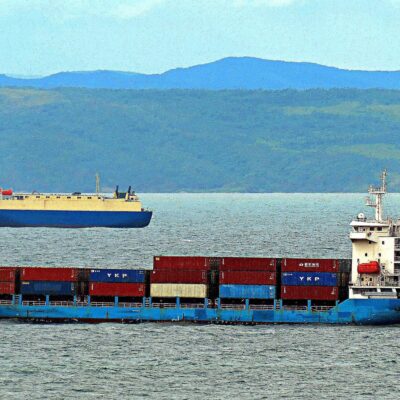
As governments try to win trade wars, they risk losing the planet

This op-ed was first published on Borderlex on 8 September 2026 here.
There is an inherent tension between protecting domestic industries and effectively combating climate change. Environmental technologies and critical materials are often the focus of trade wars.
In establishing tariffs and quotas, governments on both sides of a trade war need to ensure that environmental protection doesn’t become collateral damage.
Today’s trade wars are increasingly fought over goods and technologies that are also indispensable to tackling climate change.
In August, the United States announced new trade restrictions on imported solar products, predominantly produced in China, and banned exports of black mass battery materials and other critical-mineral scrap to bolster domestic recycling. The European Union continues to restrict imports of Chinese electric vehicles and has moved to exclude certain Chinese-made solar and battery-storage equipment from EU-funded projects.
Meanwhile, Beijing continues to wield its dominance over rare earths through export restrictions, limiting access to critical inputs for electric vehicles, wind turbines and other clean technologies.
While trade wars increasingly shape policy priorities, tackling climate change is losing momentum. Since trade wars and climate change are deeply intertwined, focusing solely on ‘winning’ a trade war risks a Pyrrhic victory – one where greater geopolitical resilience comes at the expense of the planet.
Why climate changes the game
Trade policies that address supply chain vulnerabilities and those that pursue climate goals can point in different directions.
For example, derisking from dominant suppliers such as China means reducing strategic dependencies in highly concentrated clean-tech supply chains – by pursuing industrial policy to build domestic production, or diversifying suppliers through friendshoring.
But doing so may raise the cost of at least some clean technologies, especially in the near term, risking a slower green transition.
According to 2024 International Energy Agency figures, China holds a 40% cost advantage over the US, 45% over Europe and 25% over India in critical clean technologies such as solar photovoltaics, wind and batteries.
The notion that liberalising trade in environmental goods and services benefits the climate has also shaped modern trade agreements – from Asia-Pacific Economic Cooperation to the Agreement on Climate Change, Trade and Sustainability agreed by Costa Rica, Iceland, New Zealand and Switzerland – which increasingly focus on market liberalisation for green goods and services.
Extreme supply chain concentration, however, creates a climate vulnerability of its own.
When paired with export restrictions or geopolitical conflict, it risks interrupting supplies of clean-tech goods and the critical raw materials behind them, driving up their cost.
This happened in April 2025, when China imposed export controls on seven heavy rare-earth elements and related magnets, critical components in EVs and wind turbines.
Given China’s dominance in rare-earth magnet production, the resulting squeeze forced some manufacturers outside China to reduce or temporarily halt production.
How, then, to win a trade war while fighting climate change? It requires weighing geopolitical resilience and climate objectives side by side, while getting comfortable tinkering with the technicalities of trade policy.
EV supply chains: Derisking without derailing
Take the case of EV batteries.
China dominates cell manufacturing, accounting for 80 %of global production. The EU, which aims to end sales of combustion-engine vehicles by 2035, is using subsidies and tariffs to build domestic battery production capacity.
But reducing dependence on China without slowing EV uptake is far from straightforward.
Rules of origin illustrate the tightrope countries must walk.
Because batteries account for roughly one-third of an EV’s value, they increasingly determine whether EVs qualify for preferential tariffs under free trade agreements.
Stringent rules risk subjecting EVs to most-favoured-nation tariffs – 10% in the EU – making them more expensive and slowing their adoption.
Ironically, the very products policymakers want manufactured to support the green transition are the ones least able to benefit from preferential trade.
The European Automobile Manufacturers Association warned that prematurely applying the proposed stricter rules in the EU–UK Trade and Cooperation Agreement would cost the industry €4.3bn and reduce EV production by nearly 500,000 vehicles.
But the opposite is also true: loosening EV rules of origin would weaken incentives to invest in domestic and regional battery production, reinforcing the very dependence on China that governments are seeking to reduce.
Reflecting both geopolitical and climate considerations in EV rules of origin would require progressively tightening rules of origin as alternative battery supply chains emerge, paired with targeted industrial support.
Greening steel amidst global overcapacity
Steel presents a different but equally revealing dilemma.
The EU’s Carbon Border Adjustment Mechanism, which entered its definitive phase in January 2026, offers one way – even if flawed – to reconcile industrial protection with climate objectives by subjecting imported steel to carbon costs intended to mirror those faced by European producers.
However, amid global overcapacity, governments are increasingly protecting their industries at the expense of climate considerations.
For instance, the EU’s and UK’s new steel measures impose a 50% tariff on steel imports in excess of a country’s quota – regardless of the steel’s carbon intensity.
While this might incentivise investment in green steel at home, it could leave low-carbon steel from India or Brazil facing the same 50% tariff as emissions-intensive steel, weakening investment incentives in green steel beyond Europe.
A climate-compatible trade policy must balance protecting industry from overcapacity with incentivising green production – including abroad.
This would require, for instance, lowering tariffs for green steel.
Yet doing so could bring its own set of challenges: it could undermine a country’s trade defence strategy, create the risk of greenwashing and require the next-to-impossible task of defining green steel.
The promise and pitfalls of circularity
Addressing critical raw material chokepoints through circularity appears, at first glance, to be an area where trade and climate objectives are better aligned.
Shifting from a linear to a circular economy reduces demand for virgin materials, minimising both supply chain dependencies and environmental impact.
But as countries build critical-raw-material recycling hubs, many are also introducing new trade restrictions on exports of recycled critical raw materials, seeking to leverage circularity as a resource strategy.
For instance, the EU is preparing a proposal for a 15% export duty on aluminium scrap, to be tabled in September 2026. It is also reclassifying lithium-ion batteries and black mass as hazardous waste, barring exports to non-OECD countries from late 2026. In August 2026, the US banned the export of battery black mass to boost domestic recycling.
As countries boost circular supply chains, they must avoid excessive trade restrictions that give only a select group of mostly developed countries access to secondary materials.
Failing to do so would simply turn today’s trade war over primary critical raw materials into tomorrow’s war over secondary ones, while creating a global circularity divide.
Strategic foreign direct investment workaround
Foreign direct investment is another instrument that could help square the trade-and-climate circle.
Instead of choosing between cheap imports and costly reshoring, governments can encourage investment that brings technology, production and skills closer to home.
Joint ventures and licensing arrangements can help diffuse clean technologies without fragmenting global value chains.
Already, Chinese battery and EV manufacturers are building factories in Europe, the US and other markets – while European and US technology companies are investing in Asia.
Yet this, too, comes with trade-offs: concerns over national security, continued dependence on foreign-owned firms and intellectual property and the risk of a domestic political backlash.
The real scoreboard
Reconciling economic resilience with climate objectives is fundamentally complex because success is measured through different yardsticks.
The gains and losses of trade wars are largely national and immediate; climate change, however, requires global engagement and its implications are intergenerational – even if today’s wildfires, scorching summers and Nepal’s glacial collapse are a dark prelude to what’s to come.
The trade-offs are real, and there will be no perfect solution. But governments cannot afford to fight tomorrow’s trade wars without asking whether they are also making it harder to win the fight against climate change.
Otherwise, the planet will become the silent casualty of the new era of economic statecraft.