The EU-India FTA: A Turning Point for Climate Cooperation?
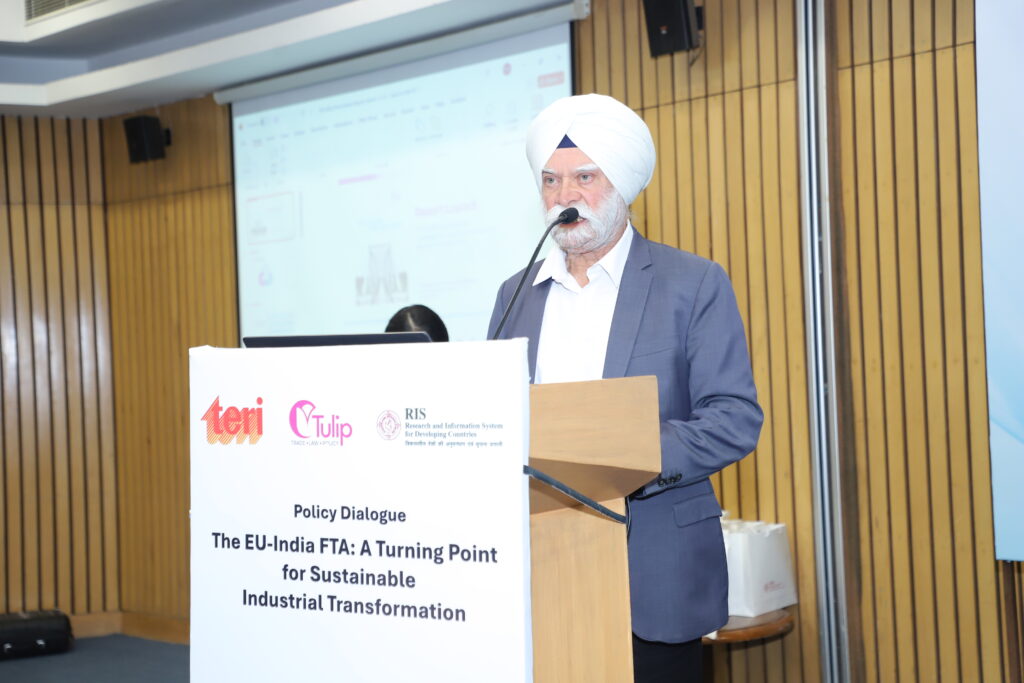
This is a repost of Ujal Singh Bhatia’s closing remarks at a high-level panel on the EU-India FTA, CBAM, and industry decarbonization, which took place in New Delhi at the India International Centre on 30 April 2026. Ujal Singh Bhatia is a former Indian ambassador to the WTO, and a former Member of the WTO Appellate Body.
“Let me begin by saying that there are significant commonalities between the EU and India on Climate Cooperation and Global Carbon Governance, and it would be unfortunate if the CBAM issue hijacks this discourse.
There are two realities that frame today’s discussion:
- The first is the EU-India FTA — an agreement we hope will soon be operationalised and which carries genuine potential to reshape the economic relationship between two of the world’s most significant trading partners.
- The second is CBAM — a measure that is now a fait accompli, whatever our views on its design or legitimacy. It must be dealt with, not wished away. But if the climate cooperation embedded in this relationship is to be meaningful, it must begin with an honest recognition of where each side is coming from — because the departure points are profoundly unequal.
Europe’s prosperity was built substantially on two centuries of carbon-intensive industrialisation, fuelled in no small part by colonial surpluses extracted from countries like India. India did not experience that growth. It was, in fact, impoverished by the colonial encounter. And yet today India is being asked to subordinate its development imperatives to ambitious decarbonisation timelines designed in Brussels and measured against European benchmarks. That is not a partnership of equals. Any cooperation that ignores this asymmetry will lack both legitimacy and durability.
The Paris Agreement, for all its infirmities, reflected a genuine attempt to build global climate governance on a foundation of justice. Its recognition of differentiated responsibilities and climate sovereignty — through CBDR-RC and Nationally Determined Contributions — was not a diplomatic courtesy. It was the moral bargain that made universal participation possible. Each country would determine its own decarbonisation path, calibrated to its circumstances and capabilities. The agreement was outcome-based and instrument-neutral.
CBAM inverts this logic. It assumes a symmetrical world. It imposes a unilaterally set carbon standard and requires exporting countries to adopt EU-compatible carbon market instruments — regardless of whether their own climate policies are delivering equivalent or superior outcomes. A country with credible NDC commitments and a genuine decarbonisation trajectory receives no recognition under CBAM if it has not replicated the EU’s chosen instrument. That is uniform responsibility with deeply differentiated consequences. These are serious normative objections.
But CBAM exists. The more productive question is how to make it work more justly — and that is where I want to focus. Take the Indian steel sector. Tulip’s very insightful study highlights its growing global significance. India’s steel output is projected to quadruple by 2050. By mid-century, India will account for nearly one-fifth of global steel production. Its current emissions intensity — the highest among the world’s top ten producers — makes decarbonising Indian steel not merely a bilateral concern but a global climate priority. This is the natural and necessary focus for EU-India climate cooperation.
Within the Indian steel sector, the picture is heterogeneous. India’s large integrated steel producers are generally well-placed to navigate CBAM. The big producers are global players and can fend for themselves. Some are already viewing it as a competitive opportunity. The real vulnerability lies with the MSMEs that account for roughly 40% of India’s steel production. These firms lack the monitoring, reporting, and verification infrastructure to demonstrate their actual emissions. Forced to rely on default values set substantially above their real carbon footprint, they face a compliance burden that reflects administrative incapacity rather than environmental failure. They are the firms most in need of assistance — and most neglected by the current CBAM architecture. To add to their troubles, the EU will continue to roll out additional regulatory requirements – TRQs, green steel standards, ecodesign, performance requirements, digital product passports. Frankly, I would be surprised if MSMEs can retain their market presence in the EU post-CBAM.
This brings me to some specific proposals for the EU, as well as for India.
For the EU:
- Your restrictions on the export of steel scrap are hurting India’s push for steel decarbonisation. Please reconsider.
- India needs access to EU’s low carbon technologies for steel making. Please consider how they can be shared.
- Harmonising the CBAM with India’s CCTS will help both sides
- The most meaningful reform available within the existing CBAM framework is revenue recycling. At present, CBAM revenues flow into the EU budget with no obligation to support decarbonisation in the exporting countries that bear the compliance burden. The EU should establish a dedicated green transition facility, funded from CBAM revenues, specifically targeting MSMEs in exporting countries — supporting MRV capacity building, technology access, and decarbonisation investment. This single reform would transform CBAM from a source of bilateral friction into an instrument of genuine industrial partnership.
For India:
- A more ambitious roll-out of CCTS, including a robust MRV system, will facilitate harmonisation with the CBAM
- We need to shed the false dichotomy between trade and climate. If we want climate justice to be embedded in trade rules, we must engage where those rules are made. The WTO is the right forum for that. If the trade climate interface is going to be regulated regardless, the question is not whether to engage. It is a question of shaping the rules or being subject to rules designed by others.”
Authors
-
 Ujal Singh Bhatia