
Advancing ASEAN’s Circular Economy: Reflections from the ASEAN Circular Economy Forum 2026
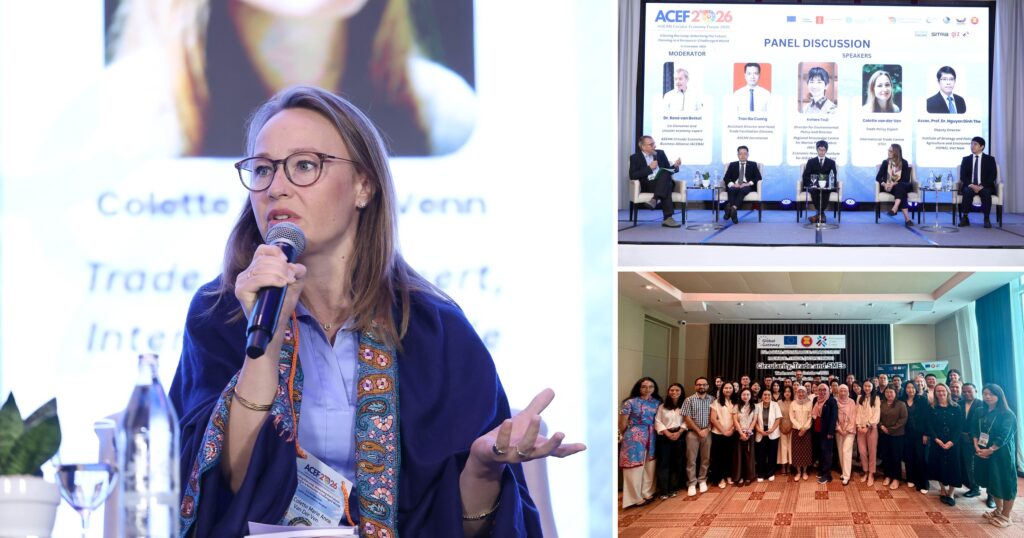
Colette van der Ven took part in the ASEAN Circular Economy Forum 2026 in Bangkok on 5-7 October 2026, at the invitation of the International Trade Centre (ITC). The conference focused on strengthening regional circular economy value chains, building on opportunities created by the upgraded Agreement on Trade in Goods (ATIGA), signed by ASEAN Member States in October 2025, and the ASEAN Framework for the Circular Economy.
Speaking at a plenary panel on “Closing the Loop, Unlocking the Future: Thriving in a Resource-Challenged World”, Colette focused on the importance of leveraging regional frameworks to create economies of scale necessary to develop infrastructure in remanufactured goods. The upgraded ATIGA provides a good framework to build on, as it removes trade barriers for remanufactured goods by allowing them to be traded “as new” products if they have (i) the same life expectancy and operational characteristics; and (ii) the same product warranty. However, only three ASEAN Member States (Brunei, Singapore, and Malaysia) have agreed to implement this provision from the outset. The others have agreed to continue to consider signing on to this provision at a later stage. The fact that Vietnam has not signed on to the provision is particularly interesting, given that it has agreed to a similar provision in its free trade agreement with the EU and as part of its membership in the Comprehensive and Progressive Trans-Pacific Partnership Agreement (CPTPP).
A key challenge to stimulating trade in remanufactured goods within ASEAN is that parts or used goods required for remanufacturing must cross borders, since firms typically designate key facilities for remanufacturing. In other words, if a firm in Singapore has remanufacturing technology for Apple products, but Malaysia does not have a similar remanufacturing facility, the used computer must be imported from Malaysia to Singapore. This can be complex if the imported product is classified as second-hand or waste. This gets at the core of the issue: the difficulty for countries and customs officials in developing regulatory frameworks that distinguish between “wanted” secondary materials and “unwanted” waste.
On another panel on “MSMEs as Drivers of Circular Economy”, the focus was predominantly on Small and Medium Enterprises (MSMEs) and ensuring that they have sufficient opportunities to develop circular business models and participate in trade. The session focuses on how MSMEs form the backbone of the circular economy and on key barriers to fostering innovation, strengthening circular value chains, and improving access to finance and trade. Colette highlighted the importance of being aware of international regulatory initiatives like the EU’s Ecodesign for Sustainable Products Regulation (ESPR), Digital Product Passports, and Extended Producer Responsibility.
She also joined colleagues from the International Trade Centre to teach a workshop to policymakers and MSMEs, finding ways to address on-the-ground concerns and explaining key trends and developments related to exporting to the EU. Key barriers that were identified include lack of testing facilities, access to finance, traceability challenges, and navigating trade requirements.
Key takeaways
1. Use the region to reach scale.
ASEAN Member States are at very different stages in building their circular economies. Working as a region is what makes it possible to collect enough feedstock and justify costly investment in recycling infrastructure. The upgraded ATIGA gives a strong framework for intra-ASEAN trade in circular goods and services.
2. Develop sector-specific roadmaps, built from the ground up.
To take ASEAN’s circular economy ambition further, Member States need sector-specific roadmaps that are part of their industrial policy strategies. These roadmaps should start by identifying the practical hurdles on the ground, then turn them into recommendations for policy change. Priority areas could include specific remanufactured goods (such as engines and digital products), lithium-ion battery recycling, and recovery of black mass, e-waste and plastic waste.
3. Make trade in “wanted” waste easier
Member States should simplify cross-border trade in valuable secondary materials. Options include green lanes for authorised operators and more detailed product descriptions in Harmonized System (HS) codes.
4. Prepare for global market requirements
Firms, industry associations and governments in the region should raise awareness of global trends that will affect the competitiveness of their circular exports. These include Digital Product Passports and the EU’s Ecodesign for Sustainable Products Regulation (ESPR). They should also invest in the infrastructure needed to comply.
5. Speed up extended producer responsibility
Member States are at different levels in adopting EPR frameworks. The roll-out of these frameworks should be accelerated, and every Member State should work towards putting EPR in place.