
Roundtable event: Leveraging trade, investment and technology partnerships to support India’s low carbon steel transition
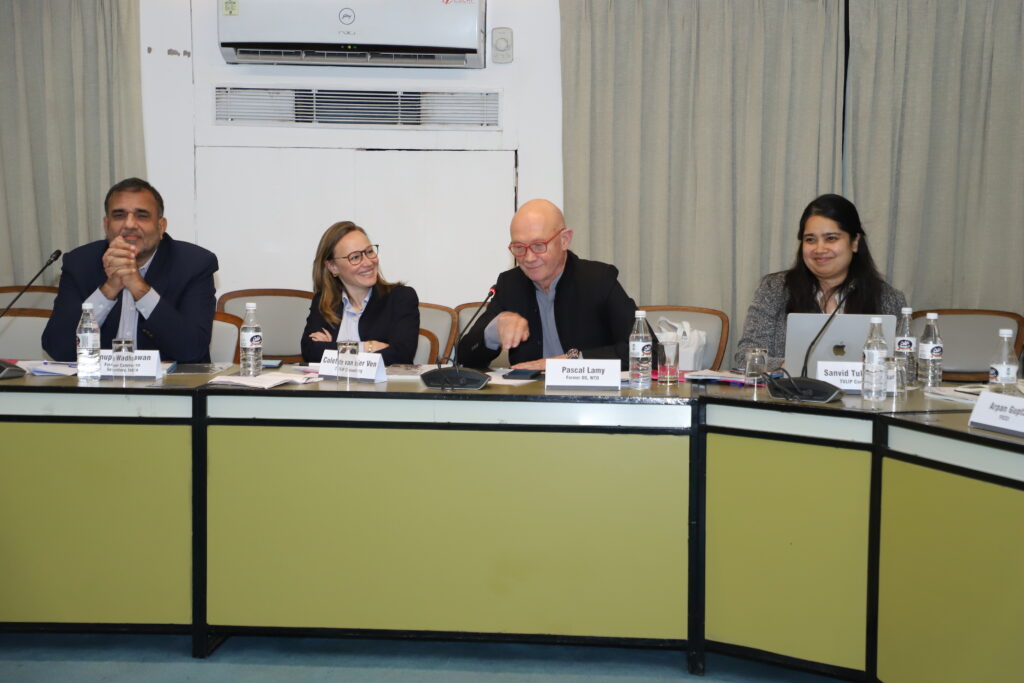
The roundtable was convened to deepen conversations on EU-India trade and its role in steel decarbonisation in India, and to identify concrete opportunities for engagement. It purposefully brought together trade, climate, and steel experts to ensure that the conversation would cut across traditional siloes, thereby enabling a more comprehensive approach.
Participants represented a cross-section of stakeholders engaged in the EU–India trade and climate agenda. Industry voices from Tata Steel and Federation of Indian Chambers of Commerce & Industry (FICCI) sat alongside legal practitioners from Clarus Law and Economic Law Practice, policy researchers from Centre for Social and Economic Progress (CSEP) and National Institute of Public Finance and Policy (NIPFP), and representatives of the EU Delegation to India.
Starting with introductory remarks by Pascal Lamy, former Director-General of the World Trade Organization, and Anup Wadhawan, former Commerce Secretary of the Government of India, a range of different perspectives were brought to the table. The EU Carbon Border Adjustment Mechanism (CBAM) remained a central theme. Participants raised concerns about its potential to erode the cost competitiveness of Indian steel exports, particularly for micro, small, and medium enterprises (MSMEs) that lack the awareness, resources, and capacity to meet compliance requirements. With MSME exports already declining during CBAM’s transitional reporting phase, participants stressed that awareness-raising, simplified compliance rules, and access to accredited verifiers are urgent priorities. Yet participants also pointed to opportunities around CBAM, such as developing carbon accounting expertise and businesses within India.
Interventions ranged from concrete, on-the-ground interventions that could be meaningful for limiting market access barriers related to CBAM and other upcoming measures, to high-level approaches that rethink the international trade and climate architecture.
Participants in the roundtable also underscored the need for the conversation to go beyond market-access considerations to address the structural challenges of the Indian steel sector’s transition. Discussions ranged across the limited availability of natural gas as transitional inputs, India’s import reliance for scrap, the concentration of green steel intellectual property among a small number of technology holders, and the limited access to concessional finance for decarbonisation investment.
The roundtable reinforced a core argument of TULIP’s report: addressing the decarbonisation of Indian steel requires a framework that integrates international trade and investment policy, climate finance, and technology transfer and co-development. The momentum around the EU–India strategic partnership, through the Joint EU-India Comprehensive Strategic Agenda (2026) and the EU-India Free Trade Agreement, presents a unique opportunity to advance on these fronts.
In person India International Centre, 40, Max Mueller Marg, New Delhi 110003 India
Speakers
-

-
 Pascal Lamy Former Director General of the WTO & Former EU Trade Commissioner
 -
 Anup Wadhawan Former Commerce Secretary, Government of India
 -
 Ujal Singh Bhatia Former Appellate Body Member, WTO & Former Permanent Representative of India to the WTO