
The EU-India FTA: A turning point for sustainable industrial transformation
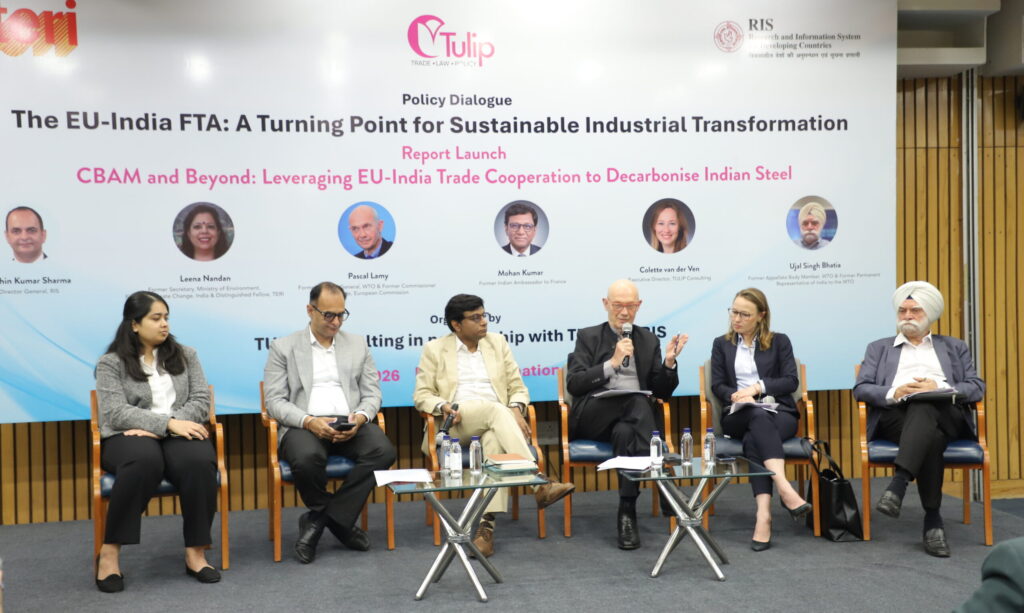
The conclusion of the EU–India free trade agreement (FTA) in January 2026, alongside the Joint Comprehensive Strategic Agenda, is a milestone. As these outcomes shift from ambition to implementation, there is potential for driving industrial transformation, including in hard-to-abate sectors such as steel: a challenge that sits at the intersection of industrial policy, climate ambition, and trade rules.
TULIP Consulting, in partnership with The Energy and Resources Institute (TERI) and the Research and Information System for Developing Countries (RIS), convened a high-level policy dialogue at the India International Centre, New Delhi, on 30 April 2026 to chart a way toward tangible outcomes, building on the momentum of the EU-India strategic partnership. The event also marked the launch of TULIP’s flagship report, CBAM and Beyond: Leveraging EU–India Trade Cooperation to Decarbonise Indian Steel, which draws on empirical analysis through over 80 interviews with a wide range of stakeholders to identify concrete pathways for cooperation on Indian steel decarbonisation.
Sachin Kumar Sharma, Director General of RIS, set the tone in his opening remarks: two decades of EU–India engagement have created the conditions for addressing even the most sensitive trade and sustainability issues. The question is no longer whether to cooperate, but how. Leena Nandan, former Secretary of the Ministry of Environment, Forest and Climate Change and Distinguished Fellow at TERI, further emphasized this point. Sustainability, she argued, is now an imperative, and India is already acting on it, through various initiatives and measures, including the Extended Producer Responsibility framework, the Carbon Credit Trading Scheme, and the National Green Hydrogen Mission. What India needs from the bilateral relationship is not additional pressure, but win-win mechanisms.
Colette van der Ven (Executive Director) and Sanvid Tuljapurkar (Lead, Sustainable Trade Law) of TULIP Consulting presented the report’s findings. They highlighted key takeaways from their research, including the asymmetric implications of CBAM for Indian steel producers, and emphasized that excessive focus on CBAM risks overlooking important cooperation opportunities for the EU and India on steel decarbonization. When using Indian steel decarbonization – and not market access barriers – as the starting point of the discussions, it opens the possibility to strengthen cooperation on investment, financial derisking, regulatory elements, and technology cooperation. This would be critical to decarbonize the Indian steel sector, which has carbon emissions 30% above the global average.
The high-level panel discussion that followed unpacked these findings, linking them to the normative and geopolitical tensions that surround them. Pascal Lamy, former Director-General of the WTO, framed the exchange around the triangle of trade, climate, and development. CBAM, he highlighted, is not a revenue instrument; it is a signal, designed to ensure that decarbonisation is taken seriously beyond the EU’s borders. But making this mechanism work for climate and development requires building the standardization and certification systems, as well as cooperation around technology and investment. He also noted the importance of reframing the conversation, highlighting the internal pressures driving industrial decarbonization in India.
Mohan Kumar, former Indian Ambassador to France, framed the discussion in the context of the Paris Agreement. Article 4, he noted, conditions developing country obligations on technology and financial support from developed countries, a principle that CBAM, as currently designed, does not adequately reflect. For the mechanism to be effective, it must provide for meaningful transition periods, differentiated treatment, and real flows of finance and technology. He also widened the frame: with only half of India built, the scale of future steel demand makes how India decarbonises a matter of global consequence.
Closing remarks by Ujal Singh Bhatia, former Chair of the WTO Appellate Body, sharpened the normative critique while highlighting the importance of practical engagement. CBAM, he argued, inverts the logic of the Paris Agreement by imposing a unilateral carbon standard, thereby displacing the nationally determined contribution framework on which the Paris architecture rests. Practically, he called on the EU to channel CBAM revenues into support for MSMEs in exporting countries, ensuring that the instrument’s proceeds serve decarbonisation goals. He also urged India to engage actively on trade and environment issues in the WTO, thereby becoming rule-shapers, not just takers.
As the EU and India move toward signing and implementing the FTA and the Joint Comprehensive Strategic Agenda, the points raised during this high-level panel will be critical in advancing EU-India cooperation on green steel decarbonisation – turning the momentum into concrete action items.
In person India International Centre, New Delhi
Speakers
-
 Sachin Kumar Sharma Director General, RIS
 -
 Leena Nandan Former Secretary, Ministry of Environment, Forest & Climate Change, India & Distinguished Fellow, TERI
 -
 Pascal Lamy Former Director General of the WTO & Former EU Trade Commissioner
 -
 Mohan Kumar Former Indian Ambassador to France
 -

-
 Ujal Singh Bhatia Former Appellate Body Member, WTO & Former Permanent Representative of India to the WTO
 -